




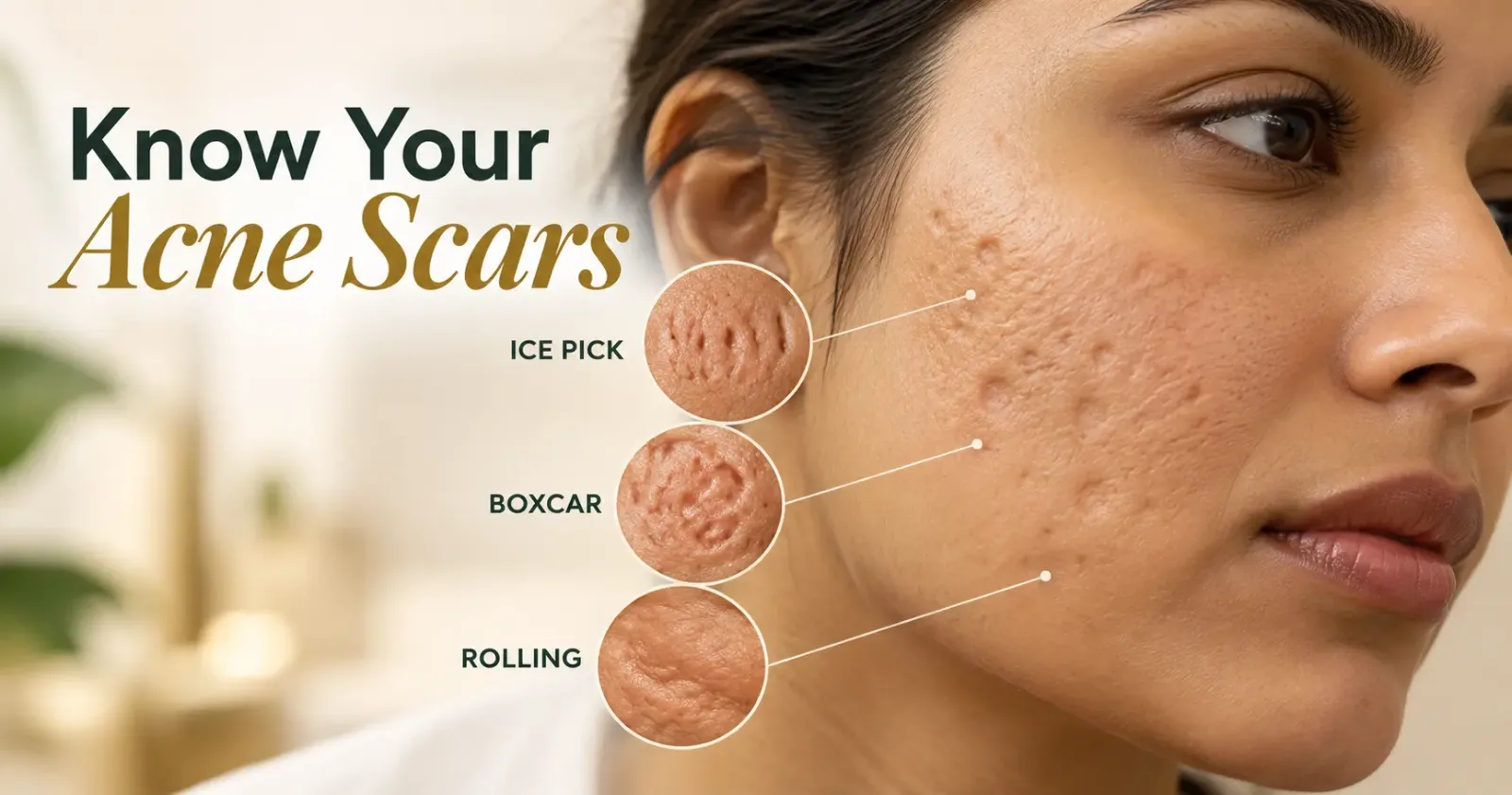
There are four main types of acne scars: ice pick, boxcar, rolling and raised (hypertrophic or keloid) scars. Each forms differently, so each responds best to a different treatment, and most people have more than one type and need a combination plan.
This guide helps you recognise your scars before your consultation. For our full approach, see acne scar treatment.
Why acne leaves scars
Deep, inflamed acne damages the skin's collagen. As the skin heals, it either makes too little new collagen, leaving a dip (atrophic scar), or too much, leaving a raised scar. Picking, squeezing and delaying treatment make scarring more likely.
Not every mark is a scar. Flat brown or red marks after a pimple are usually post-inflammatory pigmentation, which fades with time and pigmentation treatment. A true scar changes the texture of the skin.
1. Ice pick scars
What they look like: narrow, deep holes, as if the skin was pricked with a sharp tool. They are often on the cheeks.
Why they are hard to treat: they go deep into the skin, so surface treatments do not reach the base.
Treatments that can help:
Focused chemical reconstruction (TCA CROSS), where a doctor applies a strong acid into each scar to rebuild collagen
Punch excision for very deep single scars
Followed by resurfacing such as MNRF or CO2 laser to smooth the edges
2. Boxcar scars
What they look like: wider, round or oval dents with sharp, steep edges, a bit like chickenpox scars.
Treatments that can help:
MNRF (microneedling radiofrequency), which uses needles and heat to remodel collagen
Fractional CO2 laser resurfacing for deeper boxcar scars
Microneedling for shallow boxcar scars
Shallow boxcar scars often respond well; deep ones need more sessions.
3. Rolling scars
What they look like: broad, shallow waves that make the skin look uneven, especially in side light. They form when bands of scar tissue pull the skin down from below.
Treatments that can help:
Subcision, where a doctor releases the bands under the skin with a fine needle
MNRF or microneedling afterwards to build collagen
Fillers or collagen-stimulating injections in selected cases
4. Raised scars (hypertrophic and keloid)
What they look like: firm, raised bumps, often on the jawline, chest, back or shoulders. Keloids spread beyond the original spot.
Treatments that can help: steroid injections, silicone gels and, in some cases, laser. These scars need careful handling because aggressive resurfacing can make them worse. See keloid treatment.
Quick comparison
Scar type | Looks like | Often treated with |
|---|---|---|
Ice pick | Narrow, deep holes | TCA CROSS, punch techniques, then resurfacing |
Boxcar | Round dents with sharp edges | MNRF, CO2 laser, microneedling |
Rolling | Wide, wavy dips | Subcision plus MNRF or microneedling |
Raised | Firm bumps | Steroid injections, silicone, selected laser |
Why a combination plan works best
Most people have a mix of scar types. A typical plan treats the deepest scars first (for example subcision or TCA CROSS), then uses MNRF or laser over several sessions to smooth the whole area. Improvement builds gradually as new collagen forms over months. Scars usually improve a lot, but rarely disappear completely. Results vary.
Comparing devices? Read MNRF vs Morpheus 8 vs CO2 laser.
Before you start: control active acne
Scar treatment works best once breakouts are under control, because new acne creates new scars. If you still get pimples, start with an acne treatment plan. Some acne medicines, such as isotretinoin, affect when resurfacing can be done safely.
Indian skin: what to watch for
Medium to darker skin tones (Fitzpatrick III to V) are more prone to dark marks after inflammation. Doctors adjust laser and needle settings, prepare the skin beforehand and insist on strict sun protection afterwards to lower this risk.
Frequently asked questions
Which acne scar type is hardest to treat?
Ice pick scars are usually the hardest because they are deep and narrow. They often need targeted treatment of each scar before resurfacing.
How many sessions does acne scar treatment take?
Most people need several sessions, often 3 to 6 of MNRF or laser, spaced weeks apart, plus any targeted procedures. The plan depends on scar type and depth.
Can acne scars be removed completely?
Treatments can make scars much less visible, but complete removal is uncommon. A realistic goal is smoother texture and less shadowing.
Are brown marks after acne scars?
Usually not. Flat brown or red marks are pigmentation, which fades and responds to peels and creams. Scars change the skin's texture.
Is MNRF good for rolling scars?
MNRF helps rolling scars most when combined with subcision, which first releases the bands pulling the skin down.
Can I treat scars while I still have acne?
It is better to control active acne first. Your doctor may treat both together in some cases, but new breakouts can create new scars.
Not sure which scars you have? Our dermatologists will examine your skin and build a plan for your scar types. Book a consultation at any of our four clinics in Vasant Vihar, Gurugram, Pitampura or Civil Lines.